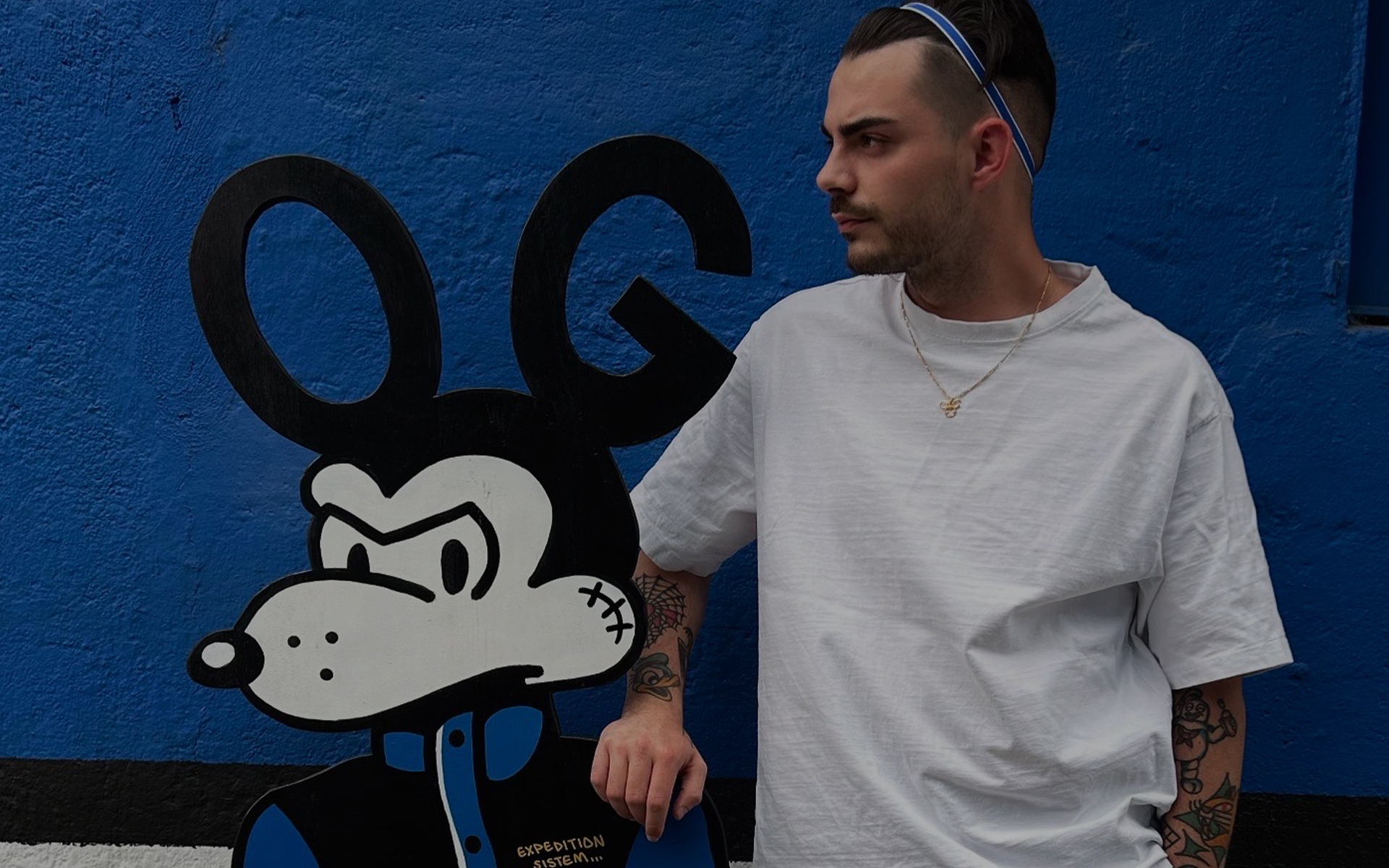
Alvaro Alonso Martin’s artistry usually begins with a coffee: coffee with milk, left beside a blank page until the ideas start to move.
Better known by his Instagram handle @Doveeone, Martin is a tattoo artist at the core, with his practice reaching across skin, paper, objects, clothing and cards, using football as a visual language.
Raised in Madrid, he grew up drawing, playing football and collecting vintage pieces, with his father at the centre of that early obsession. Later, tattooing gave those references structure – a way of turning football memory into something personal and permanent.
For the latest edition of SoccerBible’s VANGUARD series, we caught up with Martin to talk childhood icons, collectible relics and why the simplest images can carry the most weight.
How would you describe yourself, your work and the world you’re building?
I see myself as someone who uses tattooing as the main language, but not as a limitation. My work revolves around identity, memory and the symbols that define us, especially those coming from football and street culture.
I’m not only trying to create aesthetic pieces, but to build images with emotional weight. Images that connect with very specific memories people carry.
The world I’m building goes beyond the studio. It’s a universe where tattooing coexists with objects, clothing and artworks that function almost like collectible relics. What matters to me is coherence. When someone sees a piece, whether on skin or on paper, I want them to feel it belongs to something bigger. Part of a recognisable narrative.
Tell us about yourself, where you’re from and how you got into what you’re doing now. Where did it start?
I’m from Madrid, and my path starts like many artists: drawing from a young age and growing up surrounded by football, thanks to my father. He is the reason for that passion. There was already something there, even if I didn’t fully understand it at the time.
From a very early age, I used to create my own newspapers with my drawings, even full manga-style comics where I would imagine my own world and where I saw myself within it. I always had a strong fascination for the aesthetic side of football and everything that exists beyond the game itself.
Tattooing came later, but it felt completely natural. It became a direct way to take those references to another level, to make them permanent, to turn something collective into something personal.
I always wanted to step away from being “just another tattoo artist” and expand my work into other formats and techniques. Over time, I stopped seeing tattooing as just tattooing, and started understanding it as a way of reinterpreting everything that has always been with me.
You’re a tattoo artist first and foremost, but your work also moves across prints, objects, clothing, cards and football culture. How do you see those worlds connecting?
For me, they’ve never been separate worlds. They’re all part of the same language. Tattooing is the core, but there are ideas that don’t necessarily need to exist on skin. Some work better as canvases, others as toys or even garments. What matters is that they all come from the same place.
In my work, football acts as a connecting thread. It’s an endless source of symbols. When you translate it into different formats, you’re not fragmenting it, you’re expanding it. Each medium allows you to tell a different part of the story, and above all, your story.
In the end, it’s about building a coherent universe where everything speaks to each other. Someone can have a tattooed design, but also a print or an object, and everything still makes sense within the same vision.
What came first for you creatively: tattooing, drawing, football, collecting — or were they always tangled together?
For me, it was never linear. Drawing and football were always there from the beginning, very naturally. I would go training during the week and, as soon as I got home, I’d draw whatever I could before dinner. I even tried to finish school homework on the way to football just to have more time to draw.
I drew because it came out of me, and football was simply part of daily life. Over time, I started paying more attention to newspapers, Panini stickers, and that’s where collecting slowly came in, even if unconsciously at first.
Tattooing came quite naturally. I had a job that gave me a lot of free time, and I just started tattooing without much knowledge, but with a strong desire to bring everything in my head onto people’s skin.
It has always been a tool that allowed me to bring everything together and give it structure. That’s why I’d say everything has always been intertwined, just with different elements taking more importance at different stages of my life.
Do you remember the first football image, boot, shirt or player that really stayed with you?
I don’t have a single clear moment, but I remember the Euro 2008 and World Cup 2010 era very strongly, because I experienced it closely with my family supporting Spain. One moment that really stands out is Torres’ goal in the Euro 2008 final against Germany.
As for players, Cristiano Ronaldo and Ronaldinho are probably the ones I remember most from my childhood. I also remember my father buying FIFA 07 for the PSP. If I recall correctly, Rooney and Ronaldinho were on the cover. Whenever I could use it, I always chose Manchester United. Not really a conscious decision, I was too young, but my father always told me: “Pick Man United, there’s a really good player you’re going to love.” And that player was Cristiano Ronaldo.
There are always players or aesthetics that stay with you without you really knowing why at the time. But later you understand it wasn’t just the player, it was everything around it: the era, the visual identity. Those are the kinds of images that stay with you and eventually resurface in your work years later.
How do you balance memory with making something new?
I think the key is not trying to reproduce the past exactly, but to reinterpret it. Nostalgia is the starting point, not the final result. I’m interested in the emotional weight of certain images or elements, but translated into a more contemporary, cleaner language.
When you work from memory, it’s easy to fall into something literal or purely retro. I try to filter that, keep only what’s essential, and build something that feels relevant today. It’s a balance between respecting what it was and the need to create something that feels mine.
At the end of the day, if something works, it’s because it connects with someone who recognises that code, but at the same time feels they are seeing something new, not a copy of the past. And that, for me, is where it becomes interesting.
When you’re translating football culture into a tattoo or artwork, what are you trying to preserve?
I try to preserve the essence, not the exact form. I’m interested in the emotion behind the element: what it represents to someone, the memory it’s tied to, the feeling it creates.
I like reducing things to their simplest form, stripping them down to their most basic shapes and colours. In traditional tattooing, that’s fundamental: reinterpreting complex images with limited lines and shading.
A friend of mine in Segovia taught me this when I got my first arm tattoo, a simplified Donald Duck. After the tattoo, I stayed drawing with him for hours, going through books and learning how simplicity often carries more creative weight and difficulty than complexity.
It’s not about copying a shirt or a boot exactly, but about capturing what it means. A colour, a line, a small detail that triggers memory. If you achieve that, the piece stops being just an image and becomes something personal.
How does a piece usually start? Is it with a player, a product, a memory, a colour, or something more instinctive?
I always like to start drawing or creating with a coffee next to me. A coffee with milk that can last for hours. It’s my space to step away from the work and reset. Without it, I can’t really begin.
Most of the time, it starts instinctively, although there is always a trigger. Sometimes it’s a memory, sometimes an image that stays in your head, a colour combination, or even an object that suddenly comes back after years.
I’m a strong believer in freestyle. If you trust yourself, the good work comes out naturally. I like facing a blank page without knowing what will happen. You empty your mind and ideas start to come, probably from the subconscious bringing memories back.
How different is the feeling of making something that lives on skin compared to something that lives as a print, card or product?
Tattooing and physical or digital works are completely different processes. Skin is a living organ, so you have to design accordingly. It ages, gets exposed to the sun, can be damaged. That means you need simple shapes and solid fills that will hold up over time. There’s a saying I always keep in mind: if you can’t understand a tattoo from five metres away, it needs adjusting. If it isn’t readable on day one, it won’t improve with time.
A tattoo stops belonging to you the moment it’s finished. It becomes part of someone else’s body and story. That creates a different creative responsibility. You’re not only thinking about the image, but about how it will live with that person for their entire life.
Prints, canvases or products give you more freedom. You can explore concepts without the same technical or permanent constraints. They allow expansion without the irreversible weight of skin.
In the end, both languages complement each other: one is intimate and permanent, the other is experimental and expansive.
Why do you think football nostalgia is resonating so strongly with artists, designers and collectors right now?
There are several reasons. First, football from the 90s and 2000s has a very strong visual identity that now feels like a design language in itself. It’s not just sport, it’s aesthetics built around sport.
There’s also a generational factor. Many people creating or collecting today grew up with that era, and there’s a natural desire to revisit those codes from an adult perspective. It’s not just nostalgia for nostalgia’s sake, but a way of reconnecting with something that was meaningful during a formative time in your life.
At the same time, we live in a visually saturated world where simplicity and symbolism have become more valuable again. Football offers exactly that: clear icons, strong stories and immediate emotional recognition. That makes it extremely powerful across creative disciplines.