Long before Mason Mount became a professional footballer – before the fame, the scrutiny and the pressures of elite competition – there was the love of the game.
“My earliest memories [of football] are just playing around the house,” he tells me. “As soon as I could walk, probably even before that, I had a ball at my feet. It had to be a soft one because my mum wouldn’t let me use a proper ball indoors – I was breaking too many things.”
This is the sort of origin story that surfaces again and again in the world of football, yet Mount talks about it with a sense of clarity that suggests these memories still carry weight. Not long after came the familiar rites of English football childhood for Mount: Sunday League matches on sodden wet fields, playground games at school, evenings spent kicking a ball against the garden wall.
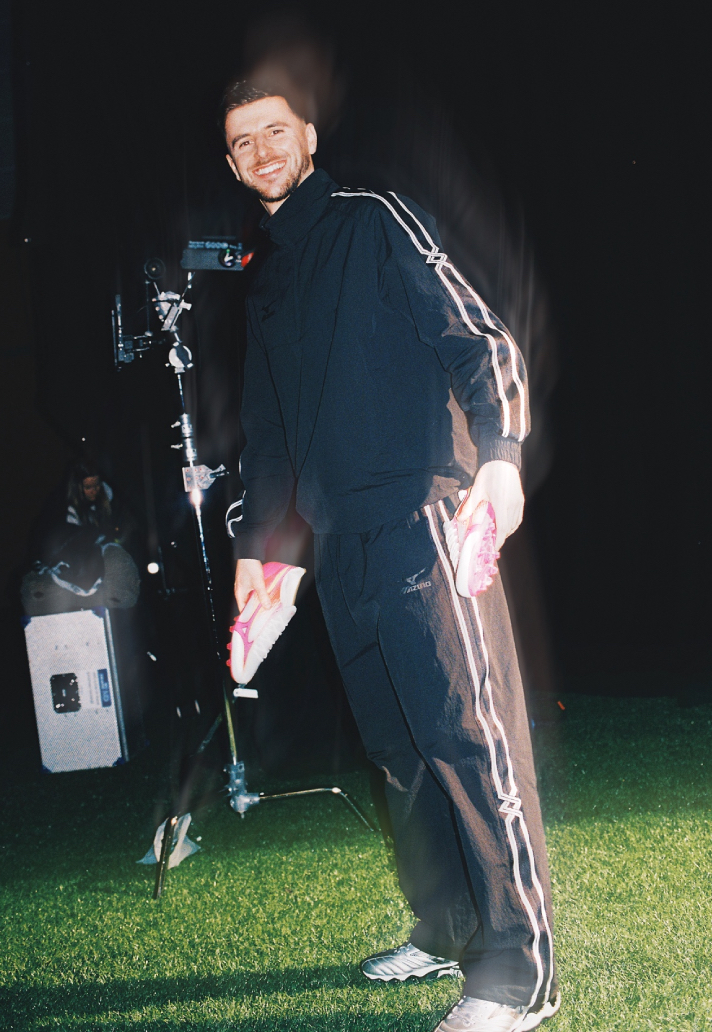

“I just remember always thinking about when I could next play,” he tells me. “Waiting for break time at school, getting home to go in the garden with my dad. That feeling never really leaves you – even now.”
We’re speaking to Mount as he prepares to be unveiled as Mizuno’s latest ambassador, joining a lineage of players tied to the Japanese brand’s quietly revered craftsmanship, and a philosophy that prioritises precision, durability and restraint over spectacle – qualities that echo in Mount’s own approach to the game.
Mount grew up in Portsmouth, a city on the south coast of England where football has long been entwined with local identity. His first live match was at Portsmouth’s Fratton Park, where he remembers watching in awe as Argentine loanee Andrés D’Alessandro glided across the pitch with the sort of confidence that leaves an imprint on young supporters.

A year later, in 2008, Portsmouth would win the FA Cup following a 1-0 win over Cardiff City at Wembley – a moment Mount experienced from the stands as a nine-year-old in nothing short of a full club kit.
“I think we [he and his dad] travelled up a couple of days before [the final],” he recalls. “I turned up to the hotel wearing a full Pompey kit, and there were loads of Cardiff fans there giving my dad some stick. I started kissing the badge and they ended up laughing.”
For many players, the distance between the stands and the pitch can feel rather abstract, but for Mount, those memories remain unusually vivid, not least for a footballer that’s seen plenty of similar scenes since. “Seeing your boyhood club win an FA Cup as a fan and celebrating in the stands like that makes you fall in love with football all over again,” he says.

What emerges from his recollections is both a sense of careful observation and a deep love for the game at its core. As a child he studied football with the attentiveness of someone almost trying to decode it in a sense. The mechanics of a free-kick, in particular, fascinated him, in particular the way David Beckham’s arm rose as he struck the ball and the unpredictability of Cristiano Ronaldo’s knuckleball.
Later in our discussion, Mount’s attention shifts towards midfielders who controlled games through subtlety rather than spectacle. I’m talking Luka Modrić, Paul Scholes, Xavi, Andrés Iniesta and the like. “These are players who could create space where there wasn’t any,” he says. The appeal, for Mount, lay in economy – the one-touch pass, the quiet orchestration of tempo.
Whoever he looked up to, it's safe to say that football has always shaped him “massively”. The rituals of grassroots sport – arriving at a muddy pitch, meeting teammates for the first time, learning to absorb defeat – offered lessons that extended beyond the game itself. “You make friends, you learn about winning and about losing. Those experiences build you and, ultimately, they shape who you are.”

If elite football often carries a reputation for insulating its participants, Mount’s way of speaking suggests a deliberate effort to maintain perspective. Family remains the anchor, so much so that both his dad and brother are present during our discussion.
“When I go home to my nieces and nephews, I’m just Uncle Mason,” he tells me. “I’m on the floor playing games with them.” He understands that the distinction is important, and that away from the pitch, the role dissolves and that perspective has become more deliberate over time.
But that hasn’t always been the case. Earlier in his career, the emotional volatility of professional sport could often be difficult to manage. “I’d get really high with the wins and really low with the losses,” he says. Now the objective is steadiness. “You enjoy the win, but you’re already thinking about the next one.”
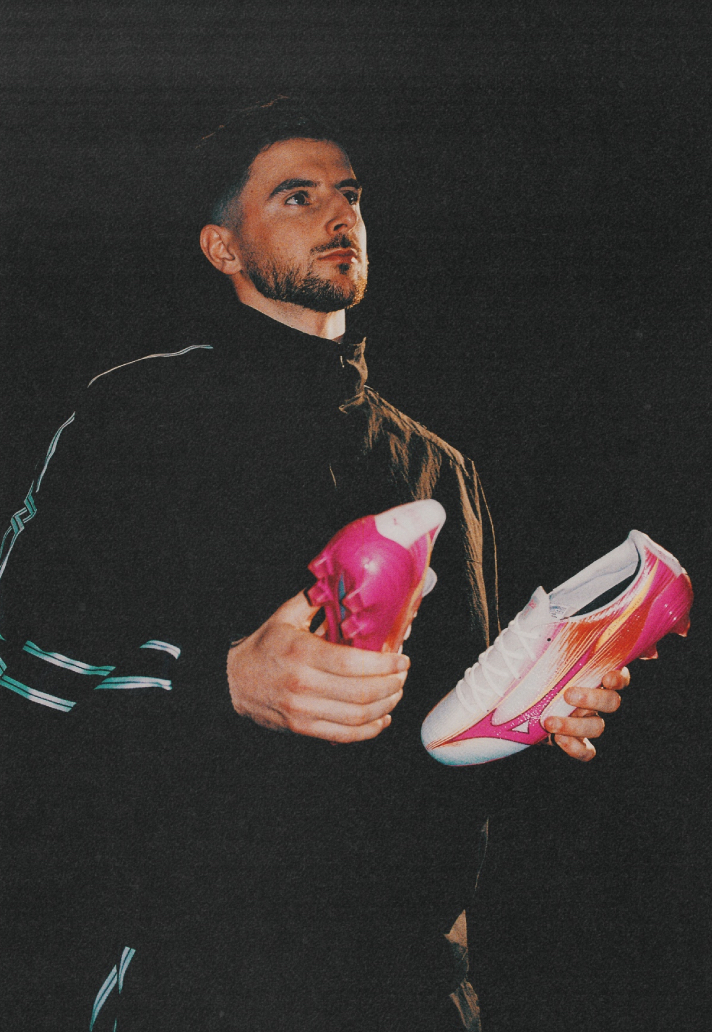
Even so, certain aspects of the game still see Mount evoke the enthusiasm of a child. Boots, for example. “Getting a new pair of boots was [and still is] everything,” he says. “It’s better than Christmas or birthdays. Opening the box and seeing the boots for the first time? It’s a special feeling.” So much so that Mount remembers his first pair clearly: the laces long enough to wrap beneath his foot several times before tying them.



To players, boots are less a fashion item than an instrument. “They’re our tools,” Mount says. “They are the only thing connecting us to the ground,” and it’s that sensibility that informs his relationship with Mizuno, the Japanese manufacturer known for its meticulous approach to craftsmanship, whom Mount has become an ambassador for through 2026/27.
Mount describes the experience of wearing Mizuno’s boots for the first time with understated satisfaction. “The first pair I got, I didn’t modify them at all,” he says. “Straight out of the box and onto my feet and into a game. They were the perfect fit from the off.”
The appeal, he suggests, lies partly in Mizuno’s philosophy – a balance of heritage and refinement that places emphasis on material and construction rather than spectacle. “To me, they [Mizuno] represent hard work, reliability, and quality. All things I pride myself on as both a player and, more importantly, a person.”


There is also the weight of lineage that comes with being a part of the Mizuno family. Famously, the boots have been worn by some of the biggest figures in the sports over the years, including names like Rivaldo, Gianfranco Zola and Andriy Shevchenko, players whose reputations extend beyond statistics and into the legendary realm.
Listening to Mount speak, the narrative does not feel like one of transformation. If anything, it feels remarkably consistent. From the child playing in the house with a soft ball, to the supporter in the stands at Wembley watching his childhood club win a trophy, to now continually learning how to navigate the rhythms of elite sport now a part of the Mizuno family, it’s all a part of the process for Mount.
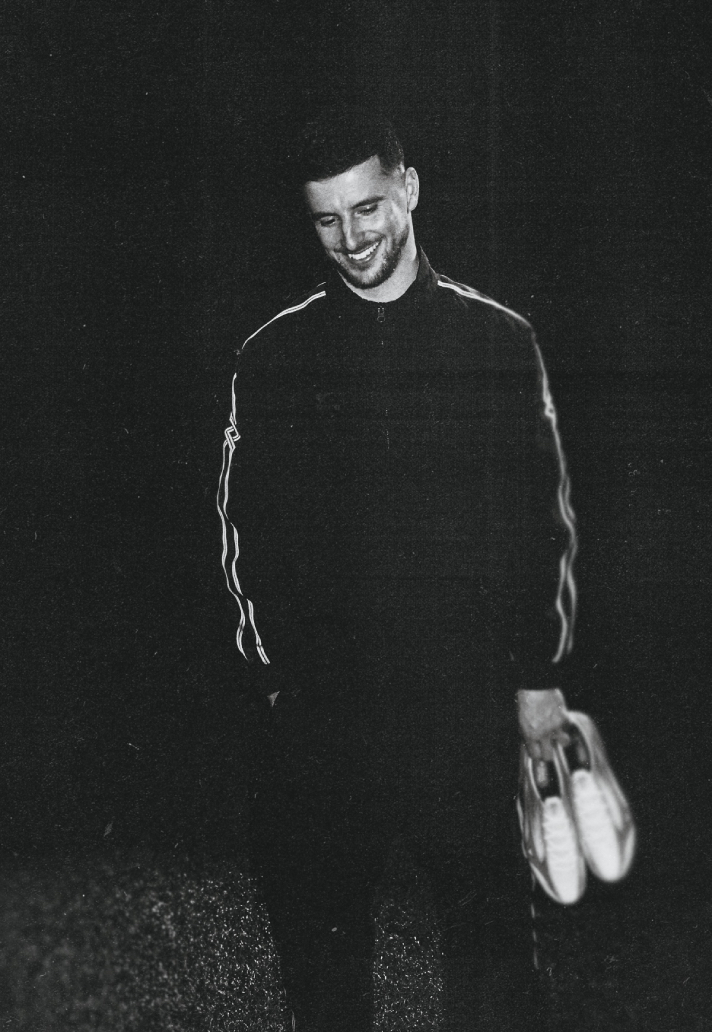
Different stages, but recognisably the same sensibility. “I just remember always thinking about when I could next play, that’s all that’s really mattered to me the whole time,” he says.
That instinct and pure love for the sport, for me anyway, is merely a reminder that beneath the layers (and layers) of modern football, at its core, the game’s most durable motivation remains remarkably simple, no matter who you are.