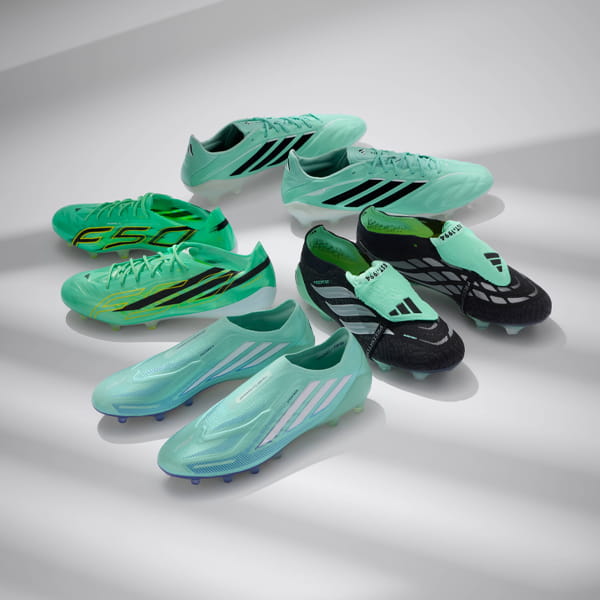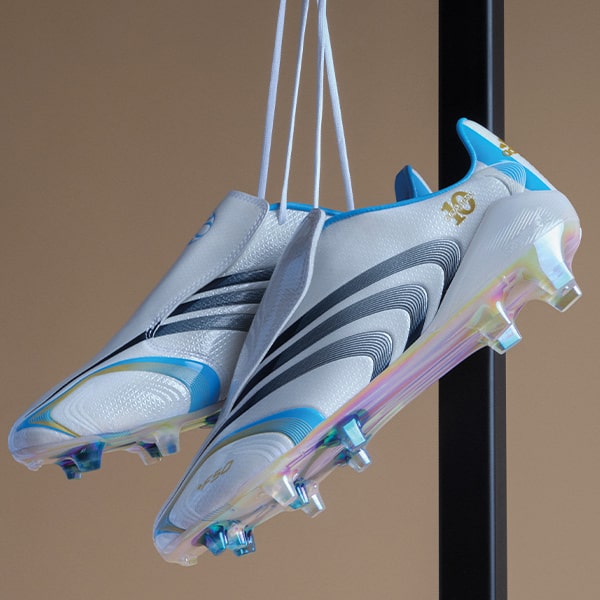
The adidas F50 has always existed at the sharp end of the game’s obsession with speed. Over the years, that pursuit has become increasingly refined, until speed and weight became inseparable.
Enter the F50 Hyperfast EVO: a 130-gram statement that not only redefines the limits of football boot construction, but that will also earn its place as the lightest adidas boot ever to appear at a World Cup when it steps up from the club game to the international stage this summer. It's the result of years of intent-driven design, radical material choices, and relentless refinement. Stripped back to the essentials, yet elevated through detail. Every line, layer and translucent panel speaks to motion, purpose and precision. It’s a boot shaped as much by athletes as engineers, built in close collaboration with some of the game’s most exciting players.
To unpack the thinking behind this new chapter of F50, we sat down with Jack Elkins, Senior Director of Product for adidas Football footwear. From multi-year design journeys and legacy decisions to the challenge of making speed feel tangible, Elkins takes us inside the process behind one of adidas’ most daring performance innovations to date.
We’ve heard all about the tech behind the F50 Hyperfast, but what can you tell us about the journey, the design process?
Specifically talking about the design, you’re looking at a two- to three-year process. When you talk about creating a performance boot, that’s definitely a full three-year journey. We start from the intent: what do we want to achieve? How light should it be? How performative should it be? What are the different elements we need to deliver?
And then of course there’s the “skin” on top – those other details that are very much connected. This F50 you see today is very much about how the stripes are placed, where the technical elements of the product go, and how those are integrated with the performance design. So yes, it’s a two- to three-year journey.

“Speed” is often reduced to weight and numbers – how did the design team try to express speed as a feeling or attitude through the boot’s visual language?
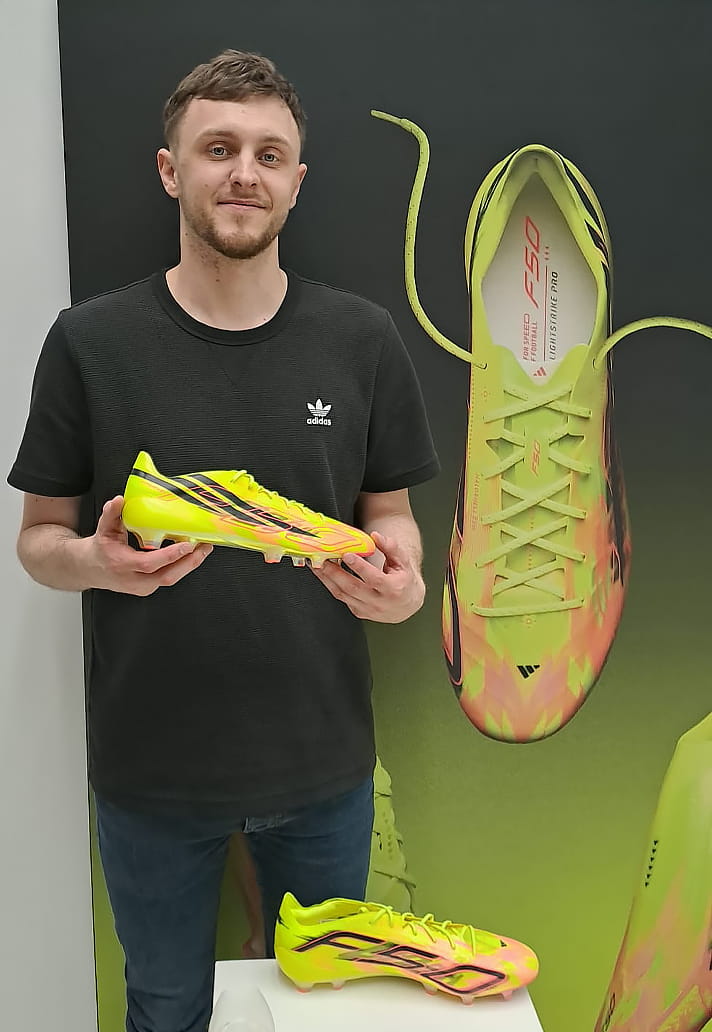
What you see here today is the Hyperfast EVO, plus the laceless and the laced versions – I’m holding the laced one in my hand now. When you want to express speed and lightness, a massive part of that is the midfoot area, where you see this translucent element. You’ve got these two different compartments: a very high-performance, very soft synthetic vamp in the front, and then, as you move through the quarter and heel zones, you see translucency and finer details. Even when you pull the tongue away, you can see your finger through it.
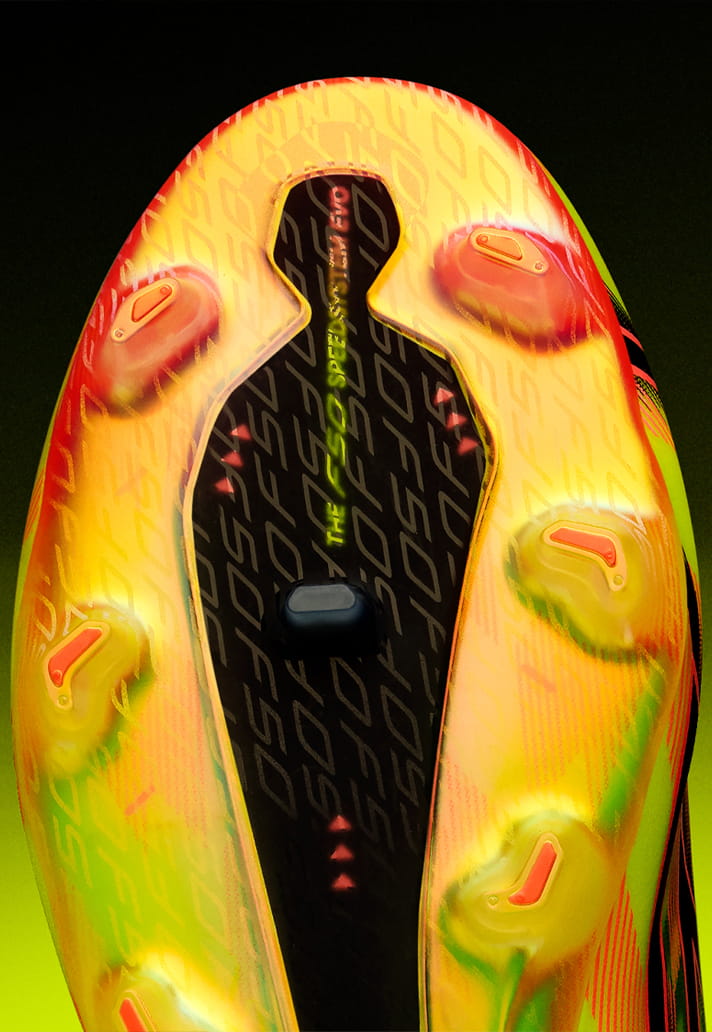
Across different colourways you see that translucency in different degrees, but that’s where the real lightweight DNA comes through. On the tooling side, there’s also a lot that’s been stripped back. In previous shoes we’ve had a thicker, more built-up rib structure. Now it’s much more refined and thin. Every detail has been considered with the question: where can we strip away weight? Where do we not need material? Where can we remove lines to make it feel sharper, lighter, and thinner?




How did you decide on this as the launch colorway?
For the launch colourway, the details are heavily inspired by Crazylight – we’ve brought that back. That’s a key part of the iconography of the franchise. The franchise has existed for 22 years, and if you look at the decade of the 2010s, Crazylight was such a powerful moment within that era. We wanted to give a nod to that.
At the same time, this boot has its own skin and its own DNA. It’s a slight variation of that classic graphic, but it feels more modern, more faded. And with the orange pops around the sprintweb and speed elements, everything feels more integrated.
The F50 has a strong legacy inside adidas – how did you decide what to respect, what to rework, and what to completely let go of from past generations?
A big part of that was not just asking people inside adidas. It was about asking people outside: “How do you feel about the F50? What does F50 mean to you?”
That journey started when we brought the F50 back for the first time just two years ago. The impact that made, and the adoption from pro players, has been phenomenal – beyond many people’s expectations. Bringing that to life the first time was already a big journey.
So when we set about this new iteration, just ahead of that original relaunch, we said: let’s continue that process. What does F50 mean to you? What does it not mean to you? Then we kept the elements that genuinely mean something to people, and tried not to get distracted by internal biases like, “Oh, I think it means this or that.” We focused instead on: what does a Dembélé think? What does a Ryan Cherki think? What does an academy player at Arsenal or Bayern Munich think—clubs that are such important partners to us?

Were there any major constraints – technical, manufacturing, or cultural – that actually ended up shaping or improving the final design?
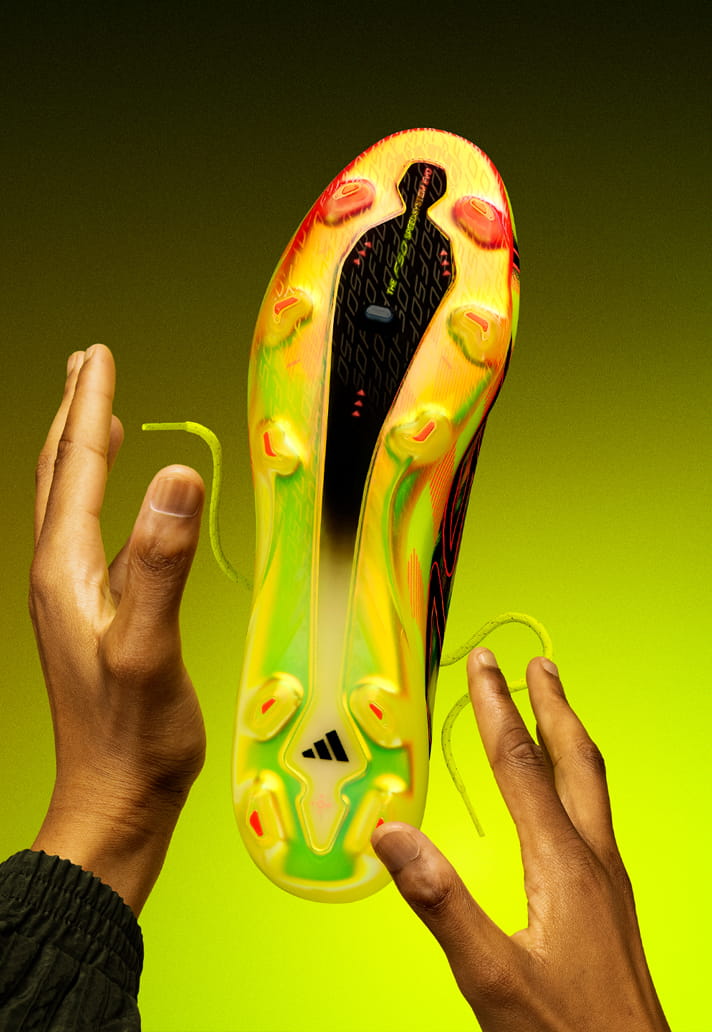
At our elite price point, one very important goal was to create an incredibly short break-in period. We wanted players to step into the boots and immediately feel, “I’m good. I’ll wear these tomorrow in a game or in training.” That’s something we never want to take for granted on any boot we make.
So within the design, you see this incredibly soft material in the forefoot, and the lines are placed in a very specific way. That’s a clear material and design choice to ensure the boot flexes cleanly, avoids pressure points, and delivers that strong break-in experience.
Laceless and laced are both key parts of our offer. When we come to the EVO, there’s even more intent behind the process. We wanted to bring an extremely lightweight package, and many players were asking, “Can I have something a bit lighter? A bit lighter?” So we really pushed the boundaries to achieve this 130-gram shoe. It’s much more stripped back, with thinner, more detailed design lines that are tightly informed by performance requirements to hit that weight. In some ways there were fewer aesthetic “choices,” because the functional needs drove so much of the design.

When you’re showing these options to professionals, how does their preference split? Do they lean more towards the EVO or the other versions? What’s their take?
I think everyone’s first impression when they see the EVO is, “Wow, this is incredible” – with maybe a couple of swear words in there! Once they put it on, as I mentioned, we give our pro players complete choice. If you’re looking for this incredibly lightweight proposition with the floating tongue, you’ve got that. We also see more and more pro players choosing laceless boots, which pushes some of them in that direction too. That’s something we’re looking into as we evolve: what does that mean for the future of F50?
Overall, we see a relatively even split, but with a bias towards laceless over laced. When a player wants that little bit of extra fit, comfort, and ball touch, they might bias towards the elite laced version. But many players are picking up the EVO and saying, “I really want to try these, I really want to wear these.” They aren’t for the faint-hearted – they’re for extreme athletes – but there’s a lot of trust in the performance of those boots.


When a player opens the box for the first time, what do you want them to feel before they even put the boots on?
The best thing we can express with this franchise, and this type of product, is that when someone buys a pair of F50s or wants to be part of the F50 franchise, it’s about wanting to cause chaos on the pitch. Being incredibly unpredictable. Being the type of player where, when you put those boots on, you might not know exactly what’s going to happen next, but you know it’s going to be something positive, because you’re creating chaos.
If it doesn’t work the first time, you go again and again. It’s that confidence to keep going at defenders, to keep being provocative, disruptive – and fast, naturally. If we had to summarise it in one thing, it’s this: when you open that box, we want you to feel the confidence to cause chaos.
From a design perspective, what does the F50 Hyperfast unlock for the future of speed boots at adidas?
In terms of the future, it unlocks a next level of insight. What we’re seeing already is incredible adoption from pro athletes in behind-closed-doors testing. When we’ve sent some of these boots out, players are stepping into them straight away.
It gives us confidence that what we’re building is exactly what those pros are looking for. And it tells us we need to continue this process into the next iterations, making sure these pro players are heard and involved throughout.


Shop the adidas F50 Hyperfast now at prodirectsport.com/soccer